
- Products & Materials
-
-
-
Product Families
-
-
-
-
Products & Materials
We collaborate closely with your team to deliver application-specific plastic compounds and accelerate your time to market.
-
-
- Industries
-
-
Solutions for Your Industry
We work with manufacturers in high-stakes industries like healthcare, automotive, electronics and building materials where performance, compliance and reliability are essential.
-
- Building & ConstructionMaterials that withstand weather, UV, and structural demands in outdoor and load-bearing applications.
- TransportationEngineered compounds built for durability, compliance, and reliability across vehicles, aircraft, ag, and power sports.
- FibersSoftness, strength, and stability for nonwovens, synthetic turf, hygiene products, and performance textiles.
-
- PackagingCustom masterbatches and additives for barrier performance, clarity, and sustainable packaging formats.
- HealthcareMedical-grade materials engineered for biocompatibility, sterilization, and global regulatory compliance.
- ElectronicsFlame-retardant, antistatic, and heat-resistant compounds for electronic housings and sensitive components.
-
-
- Services & Expertise
-
-
Services & Expertise
Americhem isn’t just a compounder, we are a full-service extension of your engineering, marketing, and product development teams.
-
-
- About
-
-
About Americhem
For more than eight decades, Americham has been your trusted global partner in designing and manufacturing polymer solutions.
-
-
- Talk to an Expert
Biocompatibility & Clean Compounding
Industries: Healthcare
Topics: Biocompatibility, Clean Compounding, Compliance, Formulation Control, Validation
Biocompatibility & Clean Compounding
Learn how clean compounding, formulation control, and process discipline help reduce variability during healthcare validation and production.
Video Insights:
- Reduce risk during validation and scale-up
- Maintain control across production environments
- Support consistent healthcare material performance
00:00:00:00 – 00:00:24:14
If you’ve worked in health care long enough, you’ve seen it. The device performs perfectly in early testing. Everyone’s aligned. The design looks solid. Then design verification and commercialization happens. And that’s when you find out whether your material choice was right. Most engineers don’t go shopping for new materials because it’s fun. They do it because it has to hit a critical to quality target.
00:00:24:16 – 00:00:34:04
And I really can’t miss in this industry. Once you’ve been burned by a supplier change or a documentation gap, you don’t forget it. I’m Matt Miklos and this is in practice. In this series, we will sit down with the people behind Americhem’s technologies and talk about what works. Not in theory, but in practice. And today, we’re starting with health care.
00:00:52:18 – 00:01:22:08
Before we dive in, I want to properly introduce you to Robert Krieger is our global development manager for health care at Americhem, bringing over 15 years of experience in compounding, laboratory, product development roles. You joined us in 2022, and you’ve been instrumental in developing and supporting our structural reinforced, our self lubricating materials, our electrically activated platform materials.
00:01:22:10 – 00:01:47:00
But, you know, titles aside, you’ve been in the lab, you’ve been in production, you’ve sat through device and product validation cycles. When you talk about what really matters in health care materials, you’re not theorizing. You lived it. Yeah. Yeah. We’ve seen a lot over the years. And when a customer is calling us, very rarely does something in our product portfolio perfectly meet all the requirements.
00:01:47:02 – 00:02:08:08
So when a customer calls us, it’s usually for a new product or a product that they’re currently running and then they’re having a problem. Either they got burned by another supplier. There’s some CTQ that they’re not quite meeting, or there’s a price issue. So that’s when they come to us. Every solution we have is going to be custom made for our customer’s specific application.
00:02:08:10 – 00:02:29:06
We will definitely draw on our previous knowledge for similar things we’ve done in the past. But most cases, you know, the reasons they call us are for complex. And that’s what we like. And that’s what we excel at, is solving complex problems for our customers. So this isn’t about our line card or or our newest product that we’re we’re trying to drive and introduce.
00:02:29:06 – 00:02:55:12
Right. This is more about, understanding what the customer CTQs are, and drawing from our, our pocket to meet those CTQs. So especially in health care, there’s a wide range of, of, of requirements, both in regulatory biocompatibility, sterilization requirements, mechanical property requirements, wear and friction requirements, or all of the above in some cases.
00:02:55:12 – 00:03:20:08
So we don’t always have, something in our product platform that’s going to meet that requirement. But we have all the tools in our tool belt, so to speak, to put together a product that will will offer a good solution. Tell me about control. It seems in this industry, that’s a word that sends engineers, you know, off their rails. Right.
00:03:20:10 – 00:03:43:12
you have a program mid launch or already launched and the change right in the middle of it, whether it’s a manufacturing change or raw material change, tooling change, you know that that’s going to set everyone back. So you know, what we make sure we do is that when we build our products, we build that with with it in mind, we make sure the raw materials we are we’re using are well supplied.
00:03:43:14 – 00:04:10:15
We, we line lock materials to certain extrusion lines. We, we lock our formulations and, you know, it’s all part of the ISO 1345 guidelines is that we notify customers of these changes if they need to be made. But we design with, that in mind. So the device manufacturer, the finished article, the OEM has to get their full device certified anyway.
00:04:10:19 – 00:04:31:19
ISO 10993. Is that the case? In some cases, it’s very part specific. Some they will need, you know, many different tests, depending on the level of patient contact. But yes, at the end of the day, it is on the OEM to decide what testing they need for their part, and to perform the testing themselves on the part.
00:04:31:21 – 00:04:55:08
Our testing that we do is so, you know, removed because from our material to the, to the molder to the actual device fit, our testing is designed only to capture the material itself. It won’t carry through, much like a UL yellow card is. Once you know, we can certify or material is is is okay for ISO part five.
00:04:55:10 – 00:05:18:14
But once somebody else touches it, the the the reading does not carry through. So this isn’t just about quality control. No, no. It’s more about formulation robustness and you know, just knowing the product, knowing that what we put in our product isn’t going to have adverse effects on the final part. And you know, passing that knowledge on to the OEM.
00:05:18:16 – 00:05:42:11
So American has this term clean compounding. A lot of our audience is probably heard of clean rooms when it comes to device manufacturing. Tell me about clean compounding. So similar to a clean room., clean compounding is all about risk mitigation, making sure that the product stays clean and pure into our process and then carried forward to our customers and our customers processors.
00:05:42:13 – 00:06:06:05
So what that means is we have, extended cleaning protocols and, process flows compared to our standard compounding. So we have, positive pressure rooms so there’s no dust buildup. We have controlled raw materials coming into that, into that room. That means no powder or liquid additives that will blow around and can contaminate from line to line, potentially.
00:06:06:07 – 00:06:36:13
And it also means taking ISO 1345 and cGMP protocols and melding it into our day to day operations. So it’s all about really, it’s about risk mitigation and risk management for our customers to make sure they know that the product we’re giving to them is, is clean and it gets passed forward to their processors as such. And what’s also good is that, you know, this is not just local to Pennsylvania here, but we also have clean compounding in Ribe, Denmark and in Suzhou, China as well.
00:06:36:15 – 00:06:54:20
So it’s a it’s an overall culture of health care. Exactly. Right. And a customer can can know that it says American. They can, you know, they can scale up their, their the production here in the States or, in other regions as well. You know, what’s better about talking and explaining this? Going out and see it. Let’s go.
00:06:54:20 – 00:06:56:12
Yes, let’s do it.
00:07:11:13 – 00:07:28:11
You can see the lighting system is state of the art. You know, you cannot see another compounding plant that has this kind of lighting. That’s just to highlight the cleanliness and make sure we keep it clean. Highlights any specks of dirt. You can see there’s literally nothing on the floor. The key to a clean manufacturing environment is positive pressure.
00:07:31:17 – 00:07:32:01
This ensures that all dust generated during the process is kept off the lines, off the material, and is collected and kept our of your product. You can see that all the feed systems are contained, so there’s no floating pellets or powders. And we have multiple feed zones. You know, any any kind of material that could potentially float away is covered.
00:07:49:20 – 00:07:54:10
We’ve got ample dust collection so all the dust will get sucked up and into the main conduit but the real story isn’t just the airflow, it’s really the discipline about operating this plant. So we have segregated storage, controlled features, batch traceability, formal change control. Again, it’s to meet ISO 1345 and GCMP, protocols. We treat these protocols not just as a plaque on the wall, but actively what we do everyday. It’s how we operate.
00:08:17:19 – 00:08:19:21
I notice there’s no forklift traffic.
00:08:19:23 – 00:08:22:04
No forklift traffic, right, because we don’t want any emissions and no carbon dust. So everything is electric, hand loaded pallet jacks.
00:08:28:01 – 00:08:29:13
So here’s our feeding system.
00:08:29:13 – 00:08:32:05
You know, this is to minimize the amount of blending and weighing and basically hands touching the material. A lot of what we’ve take here has bled over into our more industrial side of the compounding. It’s really the operational discipline that protects our customers from formation drift, contamination, out of control processes. So there are no substitutions, no incomplete documentation because surprises can be expensive. That’s really why the clean compounding matters. Sure it’s making a pure product but it is more about that operational discipline and cultivating that culture.
00:09:06:05 – 00:09:08:03
See how nice and clean things are kept.
00:09:08:03 – 00:09:13:21
Literally no pellets on the floor, no liquid spills, no powder dust on the walls.
00:09:13:21 – 00:09:22:00
This is all due to our daily operational control of this climate. And room for expansion. And room for expansion too.
00:09:23:01 – 00:09:37:02
Hey, Bobby, that was great. I really appreciate you walking our audience through clean compounding and seeing it firsthand. Hey. Let’s transition. You spent a good part of your career in health care. Why health care?
00:09:37:02 – 00:09:40:14
you know, these are parts that are important for people’s livelihoods and well-being.
00:09:40:16 – 00:10:07:02
So I find, some manner of, enjoyment in knowing that our products are going out there to make people’s lives easier. You know, make them healthier. You know, help, help people, help other people. And also, it’s a nice challenge, too. I mean, you know, a lot of the, a lot of the requirements here are multifaceted. So, I, I like playing a little bit of mad science, and I have to try to find the right product to fit all these needs is not typically one product that fits all.
00:10:07:04 – 00:10:28:12
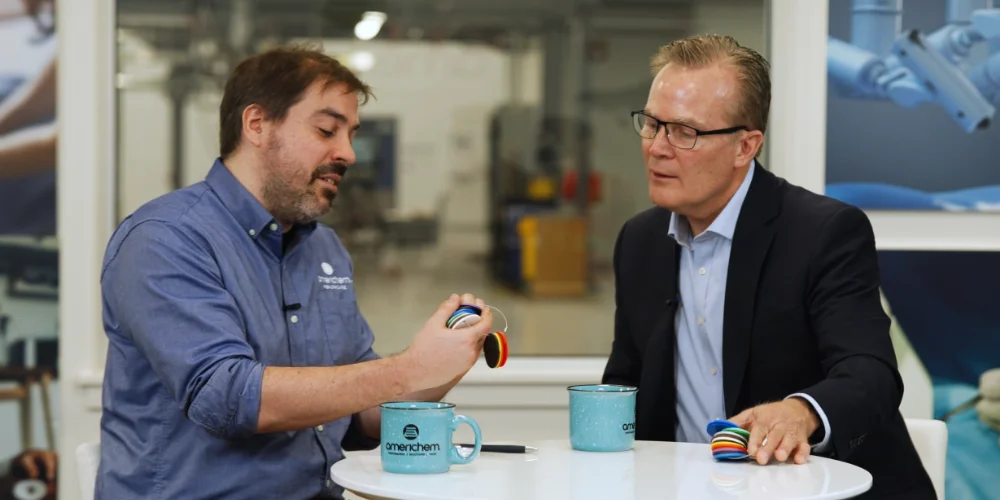
So, you know, me and my team, you know, we really enjoy solving these problems for customers. Yeah. It really isn’t just a pellet is it. No, no it’s it’s it’s the it’s the solution. And it’s, trust too. So, you know, it’s it’s important that we have the right culture going into this. That’s fantastic. Hey, I want to move on to get these beautiful colored chips here on the table.
00:10:28:17 – 00:10:57:17
Yeah. Let’s talk about color. Why would a health care engineer really be concerned about esthetics and cosmetics? Well, like, you know, like we always say about color, it’s kind of the first indicator you have of quality. If you look at, you know, say, even something like a toy on the shelf at the store, if you see all of them that are on one shade of red and one that’s a slightly different color shade of red, your mind is going to think that that one’s a slightly different color, there’s something wrong with it.
00:10:57:19 – 00:11:29:14
So color at Americhem is the experts at color for, you know, decades now, as you know, is what we excel at. So we apply the same color knowledge to the health care rigor that we have. We just have a great product. So if we if we make sure that our customers happy, with our colors and give them the freedom to choose what colors they want in their various products, and as both a level of quality assurance and also a level of customization that, our customer can be afforded.
00:11:29:16 – 00:11:48:06
So this isn’t just about picking a shade. No, no, I mean, it’s about compliance too. So, you know, a lot of, OEMs have their brands and their colors and, you know, it’s important for us to be able to meet their needs. If they want a red part, we should be able to make a red part that’s also meets all the health care requirements.
00:11:48:06 – 00:12:11:07
Okay. We’re going to move on to what I call the lightning round. Okay. Great. So don’t overthink it. Quick answers. First thing that comes to your mind, words that matter most in health care materials? I would say compliance and control. Good answers. How about the most misunderstood term in your opinion? I think the term change is thrown around kind of loosely.
00:12:11:08 – 00:12:35:09
We have a very strict definition of what constitutes change. Others, you know, it depends on who you’re asking. Health care culture, we say we live it. What does it mean to you? That means we do what we say and we say what we do. I mean, we have strict documentation and compliance protocols, and we make sure we stick to it every day and across every region.
00:12:35:11 – 00:12:59:12
You’re in the shoes of a health care device manufacturer. What would be the biggest red flag in a supplier? I would say, quality control and responsiveness to to issues. I think a supplier that cannot troubleshoot any kind of problems or get to the root cause of a problem shows that they don’t understand the material or the process.
00:12:59:14 – 00:13:19:03
How about the most important question? The engineer should ask? What is the application? What is this part going to do? I mean, it sounds fundamental, but you know, without having that first firm fundamental understanding of what you’re trying to do, it’s kind of hard to build a product around. Now that would be from our engineers talking to them.
00:13:19:05 – 00:13:35:16
Switch that around. What would be the most important question the device engineer should ask? They should be asking what can we expect with the material? How is it going to mold? How is it going to run? How is it going to do in our process? How is it different from what we’re currently doing?
00:13:35:18 – 00:13:58:11
What you know, what is the value add, I guess? Finally, what makes you comfortable specifying a compound for these critical health care devices? Again, it’s it’s our a quality control processes. You know, we’ve done the testing. All of our materials are ISO 10993 part five tested. We know the mechanical properties. We know the materials.
00:13:58:13 – 00:14:27:19
That’s important. So, Bobby, I heard really three main themes in our discussion today. One was about control. Control mattering as much as performance of the material. Second, clean compounding. It’s not just a room. It’s a it’s a system. And third, what engineers really want is predictability. What in your mind, what would be one big takeaway from this discussion?
00:14:28:01 – 00:14:32:00
I think just, you know, letting people know that we control our process.
00:14:32:00 – 00:14:44:14
so that ensures the products can perform. And we, you know, control the process from the supply chain to our process, to our QC process to the regulatory process and to your processors front door.
00:14:45:13 – 00:14:48:12
Bobby, thanks for joining us today. Yeah. Thank you.
00:14:48:12 – 00:15:04:10
That’s episode one of In Practice where color meets compliance, where clean compounding meets control. And we’re performance has to hold up not just in theory but in practice. We’ll see you next time.
And. Again. It’s.
This ensures that all dust generated walk through some of the lines here. You know, at the end of each line, we have a witty classifying deck. This is designed to knock out all the mom’s vines, to make sure quality is nice and even, you know, see, it’s nice and covered. So we’re not spilling long, fine pellets everywhere, and they’re all kicked out to a covered barrel so that, there’s no intentional contamination.
00:27:37:12 – 00:27:41:22
And on the backside, that’s just the pack out station, correct?
00:27:41:22 – 00:27:51:04
Yeah. So the material will come from the, from the classifier and get sucked up into the QC station and then look at packed out right over here. I’ve got so here it is. during the process is kept off the lines, off the material, and is collected and kept our of your product. You can see that all the feed systems are contained, so there’s no floating pellets or powders. And we have multiple feed zones. You know, any any kind of material that could potentially float away is covered.
00:28:10:11 – 00:28:34:21
We’ve got ample dust collection so all the dust will get sucked up and into the main conduit that I’ll show you up on top later. And as material runs through, here we have it set up to use the underwater Pulitzer. So, but the real story isn’t just the airflow, it’s really the discipline about operating this plant. So we have segregated storage,
00:28:34:23 – 00:28:57:21
controlled features, batch traceability, into the, the accuracy station. Right. So from here, material will get spin dry through the, this process and then classified to kick out any small or large pellets through the windy day. And, you know, you can see that the kick outs for the we detect any kind of pellet that’s the wrong size.
00:28:57:21 – 00:29:10:07
We get kicked out and at the end you have you need a finished good product that goes into the pack down stage. So let’s head up to the topic and show you the feed systems and the, Tosca.
00:29:17:11 – 00:29:19:13
I notice there’s no forklift traffic.
00:29:19:15 – 00:29:30:08
No forklift traffic, right, because we don’t want any emissions and no carbon dust. So everything is electric, hand loaded pallet jacks.
00:29:38:07 – 00:29:59:10
So here’s our feeding system. can see each line has one. You know, this is to minimize the amount of blending and weighing and basically hands touching the material. Alot of what we’ve take here has bled over into our more industrial side of the compounding. It’s really the operational discipline that protects our customers from formation drift, contamination, out of control processes. So there are no and above. Here is the conduit for the dust collection. So all lines are connected to one dust collection system, with powerful vacuum that maintains the positive pressure, in the room.
00:30:16:11 – 00:30:23:06
And it also, you know, creates the vacuum to suck up any volatiles or dust generated during our process.
00:30:23:06 – 00:30:39:10
Yeah. So once again here, some of the feeders needs to grab a metric feeder. So there are lots of plate heaters. You know, they’re very, very easy to, calibrate and control and, they, they’re able to handle a wide range of buckets, these substitutions, no incomplete documentation because surprises can be expensive. That’s really why the clean compounding matters. Sure it’s making a pure product but it is more about that operational discipline and cultivating that culture.
00:30:53:05 – 00:31:11:06
Is again you you can See how nice and clean things are kept. Literally no pellets on the floor, no liquid spills, no powder dust on the walls. This is all due to our daily operational control of this climate. And room for expansion. And room for expansion too.
00:31:11:06 – 00:31:15:13
So these are.
00:31:15:20 – 00:31:21:12
You can see the ample dust collection at each feed port all into that main line.
00:31:21:12 – 00:31:26:18
This is a more typical strand. Palletizing. So material will be stranded up formal change control. Again, it’s to meet ISO 1345 and GCMP, protocols. We treat these protocols not just as a plaque on the wall, but actively what we do everyday. It’s how we operate.
00:31:46:17 – 00:31:47:10
So we have or 3353. Right. Not yeah. 53 is this one and a call period. Yeah.
00:32:10:00 – 00:32:11:22
Yes. We can head back. Yeah.
00:36:00:20 – 00:36:07:06
around.
00:36:07:08 – 00:36:08:01
So we have And on the backside, that’s just the pack out station, correct?
00:37:20:16 – 00:37:29:22
Yeah. So the material will come from the, from the classifier and get sucked up into the QC station and then look at packed out right over here. I’ve got
00:38:11:05 – 00:38:28:17
So from here, material will get spin dry through the, this process and then classified to kick out any small or large pellets through the windy day. And, you know, you can see that the kick outs for the we detect any kind of pellet that’s the wrong size.
00:38:28:17 – 00:38:41:03
We get kicked out and at the end you have you need a finished good product that goes into the pack down stage. So let’s head up to the topic and show you the feed systems and the, Tosca.
00:41:10:21 – 00:41:27:00
You can see the lighting system is state of the art. You know, you cannot see another compounding plant that has this kind of lighting. That’s just to highlight the cleanliness and make sure we keep it clean. Highlights any specks of dirt. You can see there’s literally nothing on the floor. The key to a clean manufacturing environment is positive pressure.
00:41:30:06 – 00:41:32:02
This ensures that all dust generated walk through some of the lines here.
00:41:32:02 – 00:41:50:13
here it is. during the process is kept off the lines, off the material, and is collected and kept our of your product. You can see that all the feed systems are contained, so there’s no floating pellets or powders. And we have multiple feed zones. You know, any any kind of material that could potentially float away is covered.
00:41:50:15 – 00:41:55:05
We’ve got ample dust collection so all the dust will get sucked up and into the main conduit but the real story isn’t just the airflow, it’s really the discipline about operating this plant. So we have segregated storage, controlled features, batch traceability, formal change control. Again, it’s to meet ISO 1345 and GCMP, protocols. We treat these protocols not just as a plaque on the wall, but actively what we do everyday. It’s how we operate.
00:42:18:14 – 00:42:20:16
I notice there’s no forklift traffic.
00:42:20:18 – 00:42:22:23
No forklift traffic, right, because we don’t want any
00:42:22:23 – 00:42:28:18
emissions and no carbon dust. So everything is electric, hand loaded pallet jacks.
00:42:31:10 – 00:42:32:22
So here’s our feeding system.
00:42:32:22 – 00:42:49:10
You know, this is to minimize the amount of blending and weighing and basically hands touching the material. A lot of what we’ve take here has bled over into our more industrial side of the compounding. It’s really the operational discipline that protects our customers from formation drift, contamination, out of control processes. So there are no substitutions, no incomplete documentation because surprises can be expensive. That’s really why the clean compounding matters. Sure it’s making a pure product but it is more about that operational discipline and cultivating that culture.
00:43:09:04 – 00:43:27:05
Is again you you can See how nice and clean things are kept. Literally no pellets on the floor, no liquid spills, no powder dust on the walls. This is all due to our daily operational control of this climate. And room for expansion. And room for expansion too.
Talk to an Expert About Your Application
Looking for the right material, better performance, or technical support? Submit your inquiry and an Americhem expert will follow up.